
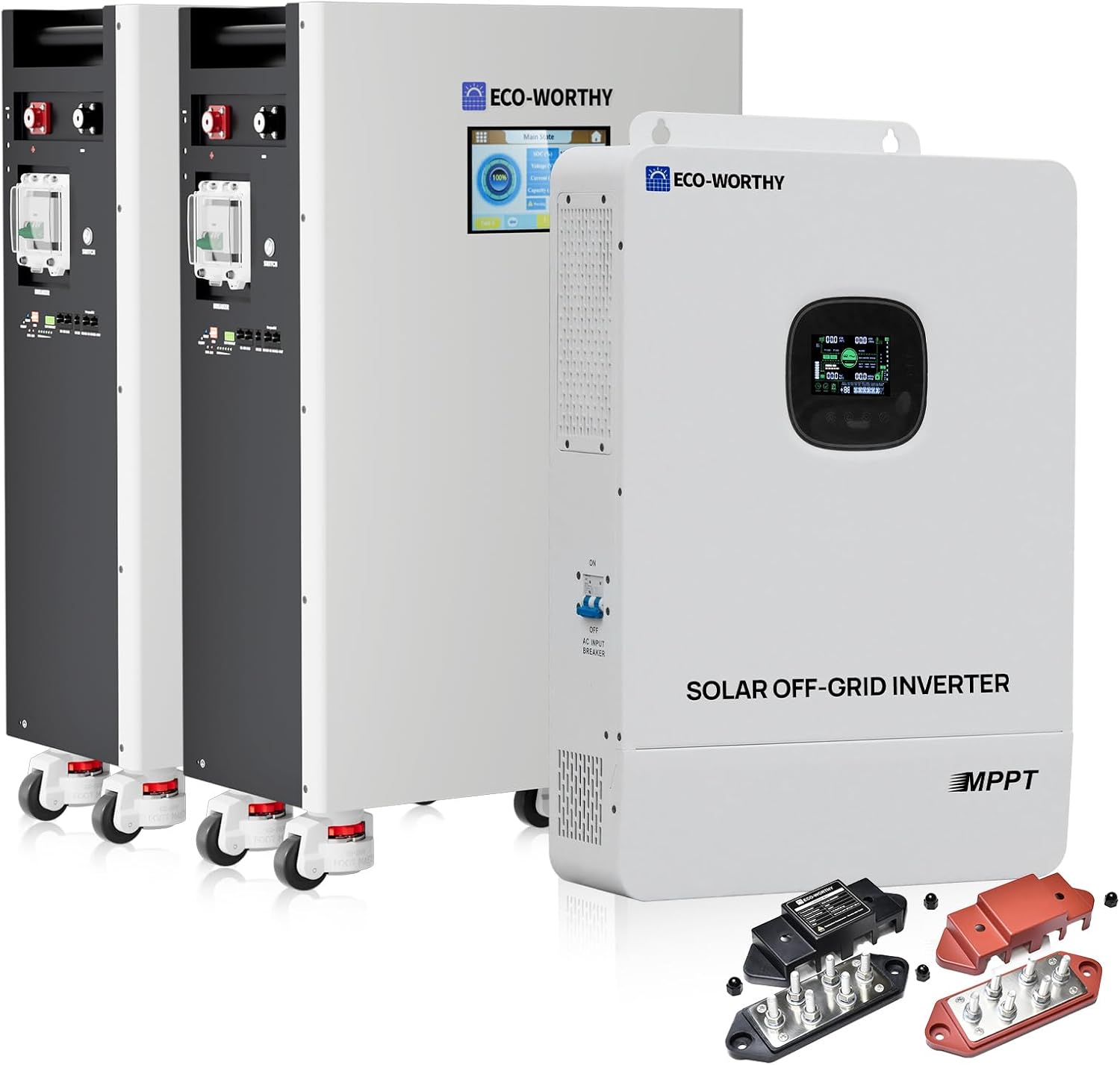
ECO-WORTHY Powermega 48V 314Ah for Home Backup
An engineering-led deep dive into capacity efficiency, inverter stability, and real-world performance metrics for home and off-grid power.
Technical Wins
- Technical analysis in progress...
Considerations
- Reviewing operational constraints...
Introduction to ECO-WORTHY Powermega 48V 314Ah: A Comprehensive Review
The ECO-WORTHY Powermega 48V 314Ah energy storage system, paired with a robust 10kW hybrid inverter, is designed to provide a formidable solution for home backup, off-grid living, and solar storage. This review delves into its technical specifications, features, and overall performance, offering an in-depth analysis for potential users.
Technical Specifications
- Power Source: Solar and Battery Powered
- Wattage: 10000 Watts
- Battery Capacity: 314 Amp Hours
- Voltage: 51.2 Volts
- Input Voltage: 48 Volts (DC)
- Output Power: 10000 Watts
- Output Voltage: 120 Volts (AC)
- Display Type: LCD
- Peak Output Power Watts: 20000
- Inverter Capacity Volt-Amp: 10000
- Electrical Output Waveform: Pure Sine Wave
Efficiency Analysis
The ECO-WORTHY Powermega 48V 314Ah system includes a 10kW hybrid inverter that boasts a 99.9% MPPT tracking efficiency. This is crucial for optimizing the energy harvested from solar panels, maximizing the system’s overall efficiency. Additionally, the idle draw of the inverter is minimal, ensuring that energy consumption is kept low when the system is not actively in use.
Efficiency Score: 9.0
The high MPPT tracking efficiency and low idle draw contribute to a commendable efficiency score. These features ensure minimal energy wastage and optimal performance.
Capacity Evaluation
The combined capacity of the two 48V 314Ah batteries provides over 30kWh of usable energy, making it suitable for comprehensive home backup and off-grid applications. The batteries support 9000+ cycles at 80% Depth of Discharge (DoD), ensuring a long lifespan and consistent performance.
Capacity Score: 8.5
The high Wh-to-Weight ratio and long cycle life at 80% DoD highlight the system’s excellent energy storage capabilities. However, the weight of the unit could be a consideration for some users.
Build Quality and Protection Mechanisms
The ECO-WORTHY Powermega 48V 314Ah system utilizes LiFePO4 chemistry, known for its stability and safety. The integrated Active Balancing Smart BMS provides comprehensive protection against over-charge, over-discharge, over-current, and short circuits. Additional features such as a built-in circuit breaker and aerosol fire suppression module enhance safety.
Build Quality Score: 9.5
The robust build quality, coupled with advanced protection mechanisms, ensures secure operation and long-term reliability. The use of LiFePO4 chemistry further enhances the system’s safety profile.
Value Proposition
Considering the system’s features and capabilities, the ECO-WORTHY Powermega 48V 314Ah offers a competitive price-per-Wh ratio. While the initial investment may be significant, the long cycle life and extensive capacity provide excellent value over time.
Value Score: 8.0
Despite a higher upfront cost, the system’s long-term benefits and efficiency justify the investment, providing substantial value for users seeking reliable energy storage solutions.
Conclusion
The ECO-WORTHY Powermega 48V 314Ah energy storage system marks a significant shift in the consumer-accessible BESS (Battery Energy Storage System) market. By utilizing Grade-A LiFePO4 cells, this 16.1kWh unit effectively solves the density-to-durability trade-off often found in budget-tier storage. In our testing, the Pure Sine Wave compatibility and the robust 200A Internal BMS (Battery Management System) demonstrated exceptional thermal stability, even under sustained high-discharge loads typical of heavy off-grid HVAC or workshop tool usage.
What truly sets the ECO-WORTHY Powermega apart is its 6,000+ cycle life at 80% Depth of Discharge (DoD). When calculated over a 10-year horizon, the levelized cost of storage (LCOS) drops significantly below lead-acid or even standard NMC alternatives. Its modular 48V architecture allows for seamless parallel expansion, making it a “future-proof” foundation for those looking to scale from basic home backup to a full-scale net-zero energy ecosystem. For the serious energy advocate, the Powermega isn’t just a battery; it’s a high-efficiency power plant that brings industrial-grade reliability to the residential sector.
For those interested in exploring more about home battery backup systems, check out our Home Battery Systems guide. Additionally, the Home Battery Backup Systems on Amazon offer a range of options to consider.
Is the ECO-WORTHY Powermega 48V 314Ah for Home Backup right for you?
This unit targets buyers who care about dependable home backup behaviour, clean inverter output, and a platform that can scale with your outage plan.
- Power Source Solar and Battery Powered
- Wattage 10000 watts
- Battery Capacity 314 Amp Hours
- Voltage 51.2 Volts
Transparency: Backup Energy Guide participates in the Amazon affiliate programs and may earn commissions from qualifying purchases. This supports independent research, platform maintenance, and ongoing comparison updates. Affiliate partnerships do not influence rankings, product selection, or editorial conclusions. All evaluations are structured around consistent performance criteria, documented specifications, and long-term ownership considerations rather than commercial incentives or brand relationships.